

 Facebook
 X
X
 Pinterest
 Copy Link
January home sales dip, but signs of resilience abound
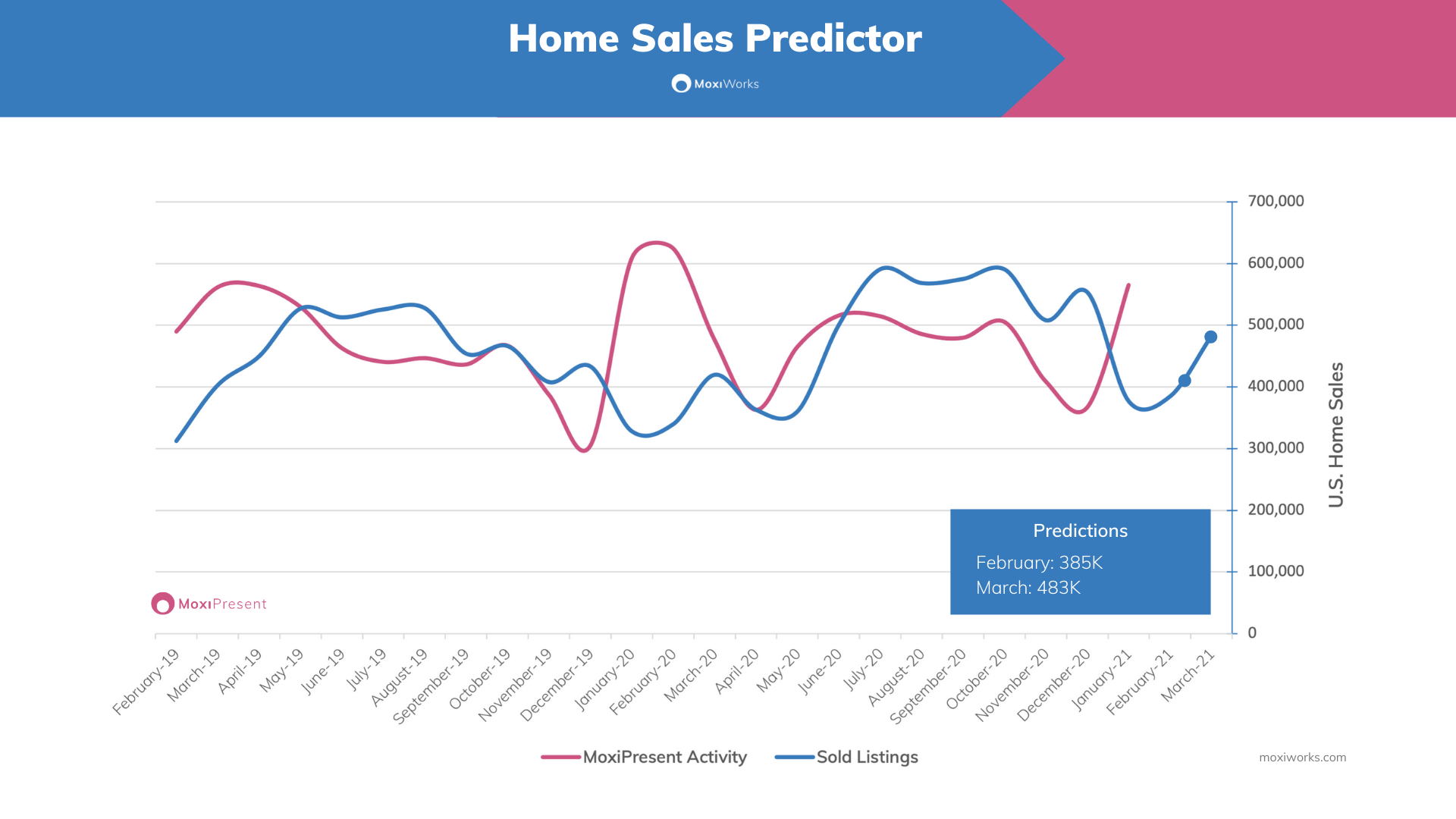
Last month we predicted that home sales in January would see a dramatic dip. It’s common in January to see a decrease in home sales after the holiday months and turn of the new year (between December 2019 and January 2020 there was a 24% decrease) and our model predicted we would see that again this month.
But then, on top of all the usual reasons for a dip, the now historic month of January 2021 happened.
Before you roll your eyes and say ‘yes, every month has been unprecedented,’ ‘every month has been unpredictable,’ January was an entirely different animal.
January was the worst month on record for the pandemic. As of January 27, 2021, we lost nearly 80,000 people in the U.S. to the coronavirus, just in January.
That is an unimaginable loss.
Then, there was also an insurrection, an impeachment, and an inauguration like we’ve never seen before. It was not your typical month, even by 2020 standards.
So, it’s really no surprise that the result was home sales dropping more month-over-month than they ever dropped during any month of the pandemic. During the pandemic, the biggest drop we saw was a decrease of 14% between March and April of 2020.
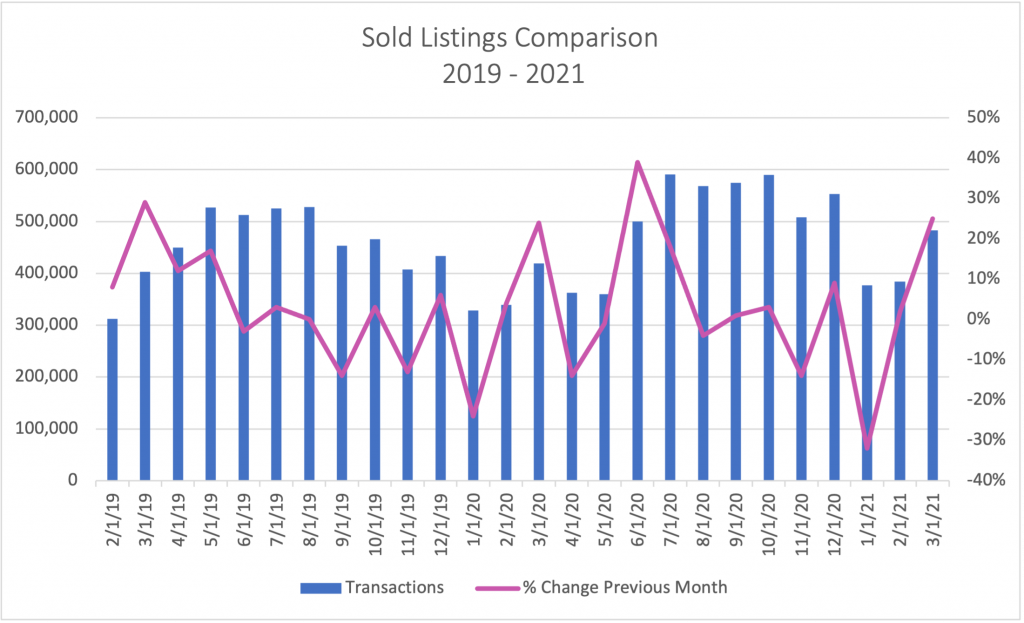
Source: MoxiWorks Month-Over-Month Sold Listings (February and March are predictions*)
The good news is though, that we are not worried. As we have said time and again during all of this, we are resilient. This industry is resilient.
We’re confident and still hopeful that sales will pick back up very soon. Our predictor has remained directionally accurate each month, and we predict home sales to pick back up in February and in March with a 2% and 25% increase month-over-month respectively.
February and March Home Sales Prediction
Based on activity inside our products in February we predict there will be 385K home sales and in March there will be 483K. You can see the full scope of these predictions below.

With our predictions that means the number of home sales in February would be 13% higher than they were a year ago and for March there would be 15% more home sales than there was this time in 2020.
All signs pointing to recovery from the last few months.
Brokers and Agents. This is your time.
January proved once again the absolutely crucial role real estate agents play in helping their clients buy or sell a home.
Agents have always had an enormous role to play when it comes to the sale of a home, but right now, as the level of stress people are under continues to tighten its grasp, a professional and quality real estate agent is crucial to keep our ecosystem running. High-quality brokers and agents are needed to advise, mentor, and guide their clients during the buying and selling process, now more than ever.
Our communities have always and will always need you. Hear us as a technology company when we say, let the computers do the things computers are good at so that you can continue to do the things that humans, and only humans, are good at. Building relationships, showing compassion, and helping people buy and sell their homes to continue to build a better life for themselves.
We look forward to hopefully reporting back some positive outcomes for February, March, and beyond!
The Home Sales Predictor is a brand-new set of prediction data that dives into the number of presentations created and the correlated number of U.S. home sales. This data is provided by MoxiWorks with insights from their MoxiPresent product.
Get our Home Sales Predictor Monthly Report delivered to your inbox!
The cure for the inventory shortage is sitting right in front of us
The Home Sales Predictor shows a continued increase in home sales as we move into 2021
We learned a lot in 2020.
We learned how to innovate in all new ways. We learned how to pivot at a moment’s notice as shutdowns spread. We learned new ways to use our technology. And, as Helen Hanna Casey put it during last week’s RISMedia’s Rocking in the New Year event, “we are better prepared than any year beforehand.”
While there was a lot we’d like to leave behind in 2020, these lessons learned, and skills gained are something to be grateful for.
One of the things that came out of 2020 for us at MoxiWorks was our Home Sales Predictor. The Home Sales Predictor predicts the trends of real estate agent activity within our products and the correlation to closed residential real estate transactions. And our predictions have been within 2% of the actual number of home sales each month.
It’s been so encouraging to see the way our industry bounced back this year and it seems that trend is bound to continue. Let’s take a deeper look.
2021 Homes Sales Predictor – January & February
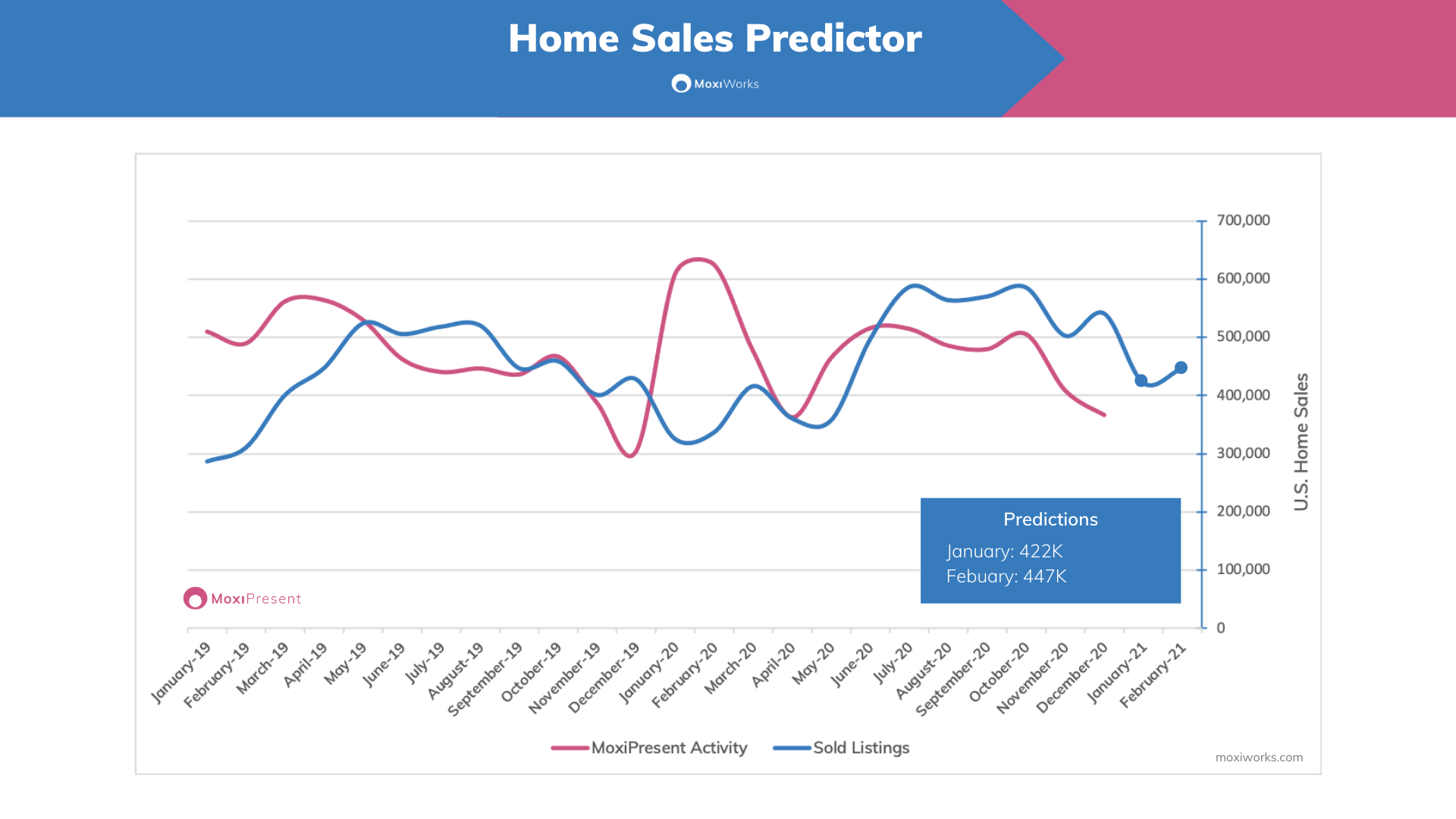
Based on activity inside our products during November and December of 2020, we predict there will 422K and 447K home sales in January and February respectively. Take a look at the graph below to see the continued trend of this correlation.
Source: The MoxiWorks Home Sales Predictor – January 2021
The graph above shows there was the usual dip we would expect to see around the holidays (everyone needs to take some time to rest and recharge, especially this year). But, we are confident we will see the trend of home sales continue to pick back up as we are already expecting to see a 30% increase YOY from Jan 2020 and a 33% increase YOY from Feb 2020.
Curing the inventory shortage
“For years we’ve discussed that there is no need to limit ourselves to an average of only 5 million home sales each year,” said MoxiWorks CEO, York Baur.“So why has the industry continued to settle at this milestone?”
In 2020, there were 5.65 million home sales AND that is with a pandemic vs. the 5.25 million in 2019.
“For better or worse, this pandemic forced many agents to do what they hadn’t always done before and that’s make the market,” said Baur.
The inventory is there, it just has to be uncovered.
Let’s make the market
This is our battle cry for you and your agents for 2021. Don’t be a victim to the market, make the market.
Be proactive and give your clients the knowledge they need to make the decision to sell their home. The more knowledge you can disseminate to your clients, the more likely their confidence grows to transact. Agents should be a trusted resource who gives their clients annual, or even quarterly, property reviews keeping them abreast of their homes worth, but also the worth of homes in their area.
“2021 is going to be the year where the agent and brokerage that knows how to get listings is going to drive by the brokerage that is too focused on buyers,” says Baur. “If you can be better at finding and winning listings than your competitor, you are going to win.”
2020 proved that we can make the market. So let’s get out there and sell more homes together.
The Home Sales Predictor is a brand-new set of prediction data that dives into the number of presentations created and the correlated number of U.S. home sales. This data is provided by MoxiWorks with insights from their MoxiPresent product.
Get our Home Sales Predictor Monthly Report delivered to your inbox!
Home Sales Predictor Predicts 490K November Home Sales
It’s November. The air is crisp, the holidays are heading our way, and homes continue to be bought and sold. This has been a year of complete uncertainty, but thankfully the real estate industry has bounced back and continues to show its resiliency.
November/December Home Sales Predictor
We’re back this month for our latest predictions using our Homes Sales Predictor. Using the activity inside our presentation tool, MoxiPresent, we are able to look two months out and predict the number of home sales.
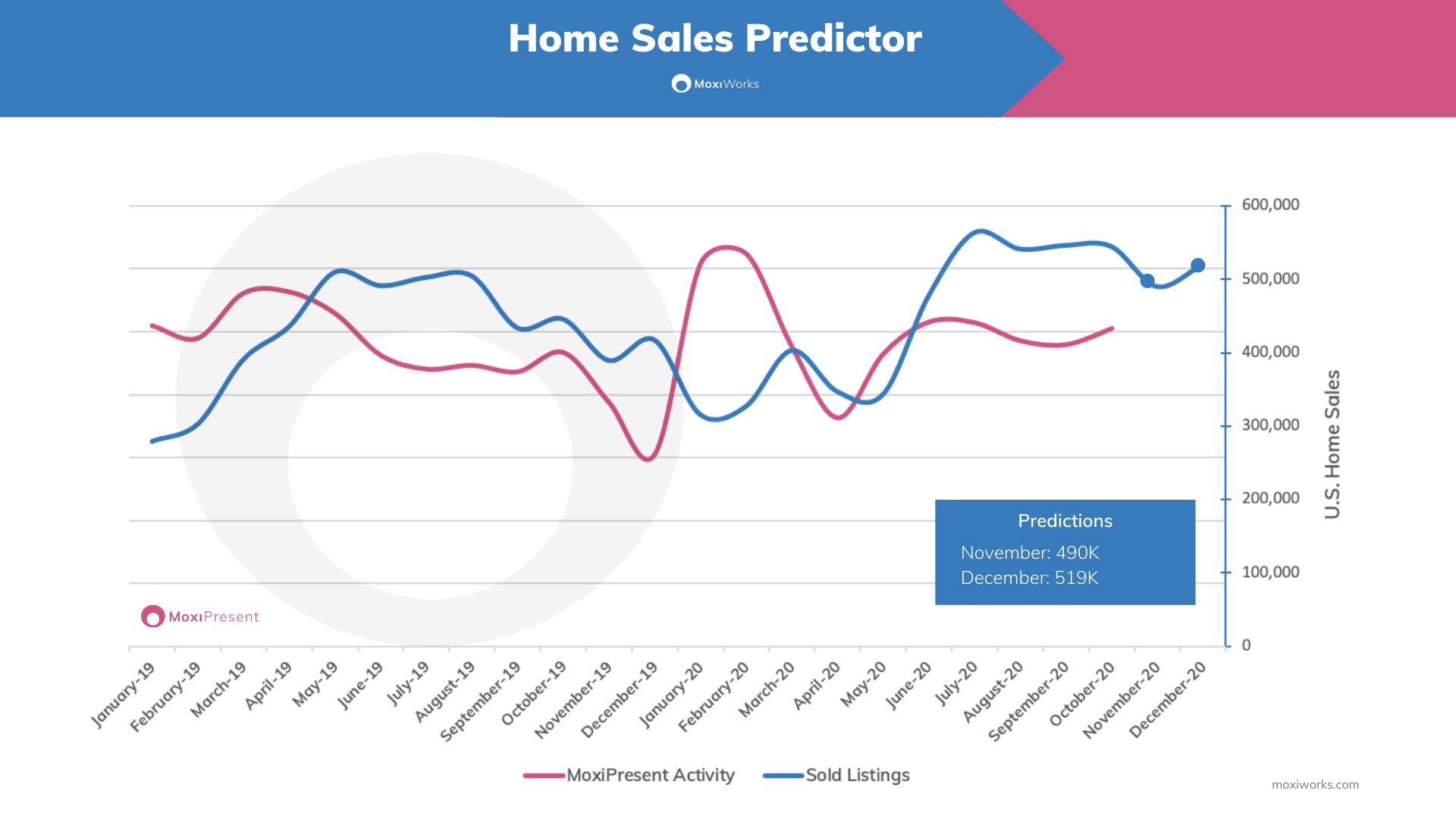
Based on the activity we saw during September and October, we are predicting there will be 490,000 homes sales in November and 519,000 in December.
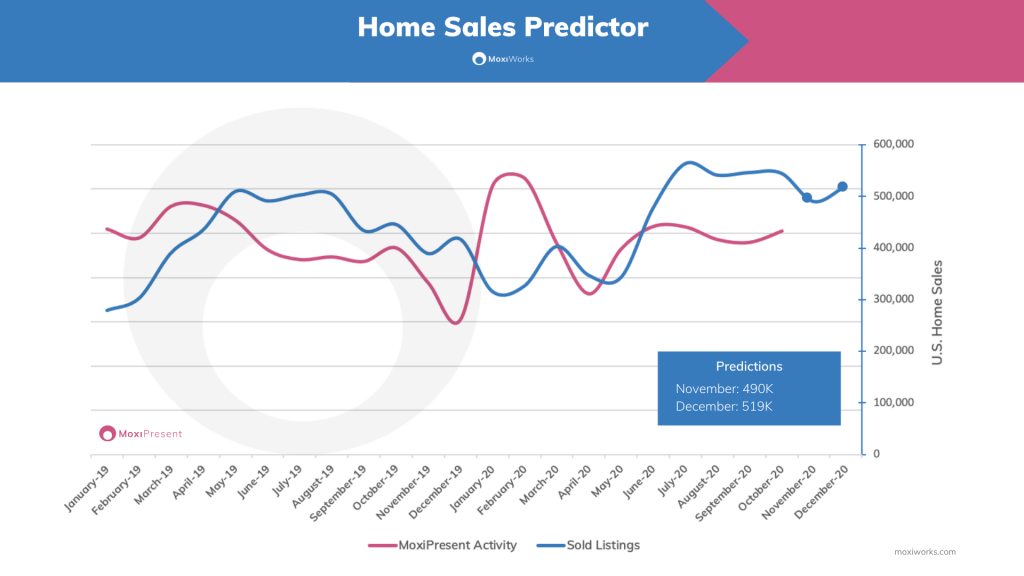
Source: MoxiWorks, Home Sales Predictor tool with predictions for November and December 2020
Some thoughts from MoxiWorks CEO, York Baur on these predictions and the market:
“The fundaments of residential real estate remain very strong – after a difficult Q2 as we entered the pandemic, the market has come roaring back in Q3, and we expect that to continue well into 2021.
While you may read headlines about looming foreclosures and other negative opinions, I believe that the market will remain buoyant through next year based on three fundamental factors:
Demand from people who are changing their housing need or location based on the work-from-anywhere trend, the fact that Millennials and Generation Z are entering the housing market in large numbers, and the prospect of continued low interest rates.
While low inventory remains a constraint, our leading indicators show that agents were in front of more consumers in October, talked to them about listing their homes, and that should bode well for December closings, as well as creating further momentum for the beginning of 2021.”
As York says, we expect to see the market continue its recovery and to remain strong. Agents must continue to stay in flow with their sphere of influence to help push to create more inventory.
We’ll see you in December!
The Home Sales Predictor is a brand-new set of prediction data that dives into the number of presentations created and the correlated number of U.S. home sales. This data is provided by MoxiWorks with insights from their MoxiPresent product.
We’ll be back each month to make our predictions on what’s to come and to also reflect on the predictions we’ve made. Sign-up below to receive these predictions in your inbox each month.
Get our Home Sales Predictor Monthly Report delivered to your inbox!
Think like a CEO: Why the Mindset Will Lead to Success

By Maddie Jostol, Marketing Manager
Agents have traditionally been thought of as salespeople, which, is understandable since on the surface that’s what they do. They sell houses. But there is so much more to it than that. As a real estate agent, you’re running your own business.
You have to take care of everything from marketing, to selling, to transaction management, and even the nitty-gritty like keeping your financials straight and properly filing taxes. You have to be entrepreneurial in that you need to take responsibilities for your business’ successes as well as its challenges, and you need to get creative when it comes to growing your business.
Here are some tips to growing your real estate business by using a CEO mindset:
Focus on the bottom line:
At the end of the day, you’re working to make a living. Just like any CEO, you have to pay attention to your bottom like and focus on activities that drive revenue growth for your business.
Get a system in place to track your sales and your expenses. If you aren’t tracking the second half of that equation, you’re missing half the story. You should always begin the year with a financial goal and work towards that. It will serve as a benchmark throughout the year to ensure you’re generating the cash you had hoped.
Prioritize:
“The question I ask myself like almost every day is, ‘am I doing the most important thing I could be doing?’… Unless I feel like I’m working on the most important problem that I can help with, then I’m not going to feel good about how I’m spending my time.” – Mark Zuckerberg, CEO of Facebook
Many agents struggle with time – there are never enough hours in the day. Because you can’t do everything. Especially as an agent, you constantly have a lot of balls in the air. You need to be able to prioritize each and every day to ensure you’re spending your precious hours on things that will truly have an impact on your business. Technology comes in handy, here. Rely on a task management system that will assist you in keeping track of everything you need (and want) to do and prioritizing them to improve efficiency.
Look forward:
“You have to be very nimble and very open minded. Your success is going to be very dependent on how you adapt.” – Jeremy Stoppelman, CEO of Yelp
Change isn’t easy. However, our industry is changing rapidly, which means you need to set yourself up for success to ensure your business will grow along with the industry and market. Be flexible, embrace change, and make sure you stay ahead of the game by adapting your business as necessary.
Think outside the box:
Get creative and be innovative. It’s ok to follow trends and use proven methods, but take those to the next level. What else could you be doing? Where else could you take your marketing efforts? Drive business by thinking outside the box and delivering service that is a step above what else is out there. In order to stand out in today’s competitive market, your marketing efforts not only need to keep up, but they need to be ahead of the game. Leverage your brokerage brand and your personal brand and think outside the box to build your business.
So, although you already wear tons of hats, it’s time to put your CEO hat on and drive your business into a successful future.
Do Your Agents Have Enough Contacts in Their CRM Sphere?

By Maddie Jostol, Marketing Manager
As seen in Mile 62 eMagazine.
Agents rely on their brokerage for coaching and guidance. Your brokerage tools and resources directly contribute to their success and are what make them feel like their career is supported. As you and your managers coach agents on the importance of a CRM and how they should best utilize such a system, guidance has to be specific. The first step to using any CRM is to get your database of contacts cleaned up and uploaded. So, how many contacts should they have in there?
Simply put, the bigger your sphere of influence, the more people within your sphere who will be buying or selling a home. Growing their sphere of influence is vital for growing a sustainable business. For agents, growing a real estate career means growing your sphere of influence. It’s all about making connections and being known in your area as the trusted, go-to person for real estate. Leads are getting scarce as the competitive market continues to heat up. Agents need a sustainable book of business filled with opportunities for repeat and referral business. So, when it comes to contacts in your CRM, how many is enough?
Historically an agents’ database was a list of contacts kept in their phone. Those days are long gone. While this is a fantastic start, an agent’s book of business requires and deserves more care than that. Those contacts should be synced with a system that enables the agent to truly engage with those people as well as organize and grow their business.
Having contacts organized and loaded into a CRM enables agents to truly nurture those contacts. They can automate touchpoints to stay top of mind, segment their database as necessary, and keep track of conversations they’ve had and the history of their relationship with each person.
So, what’s the magic number? We recommend agents have a bare minimum of 100 contacts in their CRM. Once you hit 100, your sphere likely extends past close friends and family to include contacts you can market to and generate leads from. It’s a large enough pool to ensure growth, with people who are not only part of your closest spheres, but have their own groups of friends and acquaintances to refer you to. You sphere is constantly expanding – as people in your sphere communicate with their own sphere, your reach increases.
We recently looked at user data for our Moxi Engage CRM – focusing on users with at least 100 contacts, three or more sales flow conversions, and three or more contacts in an automated marketing programs. We found that these users typically close 31% more sides than users who aren’t leveraging the system in such a way.
At the heart of the sphere-selling methodology is relationships. Each person in an agent’s database represents a relationship that will contribute to their success. Referrals are the highest quality leads you can get other than repeat business. A strong sphere is the number one way to generate referral leads, as long as that database is well taken care of.
Defend Your Brokerage Fortress: The Solution to Margin Compression

By York Baur, CEO of MoxiWorks
As we all know too well, there’s a feeling of impending doom when it comes to the future of dollars retained by the brokerage. Brokerage margin compression has been accelerating in the past few years especially, but no one seems to be discussing legit ways to battle it. And last I checked, hope is not a strategy.
A few Moxians attended the Gathering of Eagles event that REAL Trends puts on every year, and here’s what the retained company dollar average for brokerages across the nation looks like over the past several years:
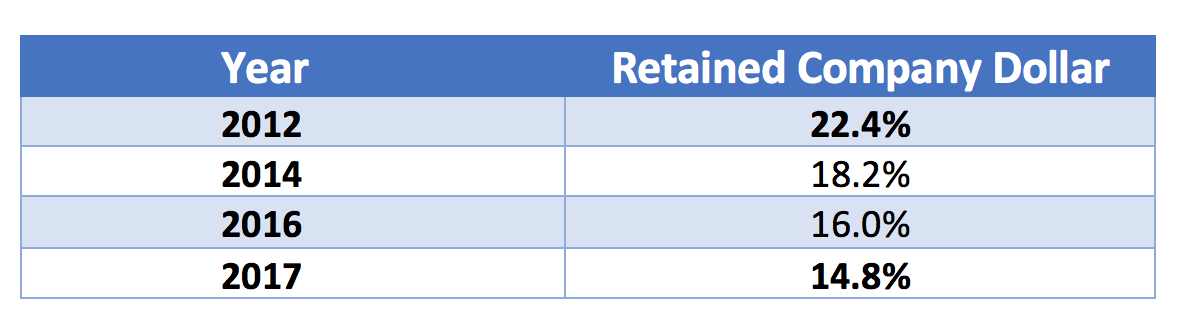
The brokerage dollar is ever-shrinking. Some may argue it isn’t a big deal since home prices have gone up, compensating on a raw dollar basis. That only works in a market with rising prices, and we all know that merry-go-round will stop at some point. We need a real plan for dealing with margin compression – it’s a core problem our industry faces. Don’t forgot that 25% of the RealTrends 500 didn’t make it through the last recession. Do you want to be part of that 25% when the next one hits?
In the face of all of this the “disrupters,” as they like to call themselves, are putting massive pressure on the need for the brokerage to have a technology offering to their agents and technology isn’t cheap. Even as a technology guy myself, I am not shy to admit it. So, how do you thread that needle? How do you buy the best technology, so you can have the best offering to agents in a world where you, the brokerage, don’t have margin to work with?
To preface this, I absolutely stand by my original viewpoint that the traditional brokerage, the impenetrable fortress that it is, has the most valuable asset that exists in the entire industry: relationships with agents, and the agents with the consumers in their sphere of influence.
With that said, here are what I believe to be viable elements of a plan for traditional brokerages to combat margin compression.
Open Platform – Not a shocker
You all knew this was coming. I won’t dive deep, but future-proofing can easily be done by getting your brokerage on a proper open platform that allows you to plug in new tools and unplug old tools just like power strip. Having an open platform means retaining your current technology investments and maintaining a foundation for all the technology changes to come in the future. And don’t be scared by claims that the disruptors will build better technology themselves internally. Over $1B has been invested in real estate tech each of the last two years, so no one company has a lock on building the best technology in every category. Having an open platform that allows you to take advantage of the best of real estate tech today and in the future trumps a “we can build it all” approach every time.
Say it with me: Recruiting, retention, AND productivity
Pick great tools that actually drive agent productivity as well as recruiting as retention. Industry wide, if you ask any broker, “what’s the most important thing in your business?” they’ll say to recruit and retain. But that’s wrong. It should be recruiting, retention, and productivity. If you focus on productivity as a major pillar of your business, it amplifies your recruiting and retention, and it’s where you actually make money. Having non-productive agents at your brokerage doesn’t make you money, it costs you money.
Many brokerages chase the shiny object, so it enhances their recruiting and retention efforts, but it doesn’t move the needle. To that point, it’s imperative to eliminate the shiny objects and steer clear of the temptation of them. They will end up costing you more than you ever thought.
Technology is NOT a single expense line item
Don’t think of technology as a single expense. Think of technology and marketing expenses together, because the two worlds have fundamentally blended. Digital marketing is inherently fused with technology and the other way around. As proof of this, an ongoing trend across all industries is the blending of the CTO and CMO roles.
Technology is not a necessary evil expense item, but as something to be used along with other marketing activities as a combined marketing and technology spend. What form of marketing these days doesn’t involve technology? Almost none.
And while I’m on my soapbox, can we please stop talking about expenses and start talking about investments? Every decision you make to spend money on something should be thought of as an investment. That means that you should expect to have a return on your investment, have a plan for making your investment work, and measuring your return over time. For example, in our case we check agent performance with our tools – agents in brokerages that are our customers do 40% more transactions when they use our stuff. That’s real productivity, and real top-line growth. Make investments and grow your business versus “managing expenses” like an accountant.
Trying to save your way to prosperity almost never works, so get on with a proactive plan to invest in a technology platform and tools to boost agent productivity. Not only will your top line grow, but you’ll be able to better stand your ground in negotiations with agents over their split, because they’ll understand that you’re helping them grow their business vs. just offering them a desk and the ability to rent your brand.
My call to action: have a plan. Focus on agent productivity. Have goals and measure yourself to them. Use technology and digital marketing to support your plan. The great news is that the traditional brokerage fortress is very hard to penetrate. But even the most impenetrable fortress can get sacked if the King doesn’t have a plan for defending it.
Goal-Setting 101: Set Yourself Up for Success This Year

By Maddie Jostol
2018 is your year to not only reach, but to exceed your business goals. If you either a) didn’t set goals for 2018, or b) have already lost track of them, making you think that maybe you didn’t go about goal-setting in the best way, then this guide is for you. Goal-setting gives you direction. It ensures all of the work you’re doing serves a purpose. There is no one thing that you are doing to make your business reach its goals. There is no silver bullet for real estate agents. In reality, it’s an accumulation of things, which is why having goals in place is so important. It means all of those little things can map to something bigger and add up to success.
Make that money.
At the end of the day, you’re working to make money. There is no one-size-fits-all formula for how much a real estate agent (or anyone, for that matter) should make. Think about how much you need to make in order for this year’s work to be worth it. What is your time worth? How much time and effort are you planning to give? What pieces of your life do you need to fund and how much will you need to make in order to do that?
Once you take those questions into consideration, begin to form your financial goal for the year. Next, calculate your GCI (Gross Commissionable Income) goal. This is important as it’s directly relatable to the day-to-day progress you’re making. Each time you complete a transaction, you can see exactly where you are on your path towards your annual goal. If you’re a Moxi Engage user, be sure to input your GCI goal in your Moxi account. This way, you can easily see your goal reflected on your Moxi dashboard, as well as the progress you’re making towards it.
Get real.
It’s really important to make your goals realistic and achievable. Of course, we encourage you to stretch yourself and reach for the stars, but make sure your goals are within reach. The last thing you want is to get discouraged and leave your goals behind altogether.
Follow through.
We’re all too familiar with the new year’s resolutions that fizzle out after a month or two. We’re hitting that point in the year when the gym is quieting down drastically after being packed for the last few months. Why? Because without a plan, it’s inherently difficult to follow through on your goals.
When goal-setting, consider the steps you’ll need to take to reach said goals. Write them down – even if it’s a rough list. This will not only help you gauge whether or not the goals you’re setting are realistic, but it will give you direction and get you on the right track as you set out to reach those goals.
Get your ducks in a row.
When your business runs smoothly, you’re better prepared to reach your goals. Part of goal setting should be getting the right systems in place for you to surpass those goals. As an agent, you are running your own business, which means accounting and tax filing take up time you could be using to close more deals. As independent contractors, most agents struggle with proper accounting since keeping your business finances sorted is such a pain. When it comes time to file taxes, you’re left sifting through a box of crumpled receipts and losing out on deductions because you didn’t have time to record and categorize everything.
QuickBooks Self-Employed helps independent contractors keep track of their finances all year, saving time and stress. When it comes time to file taxes, all of your expenses are auto-categorized to match your Schedule C and the average user saves $4,340 on taxes. With a snapshot of your business income vs. expenses, available on your app in real time, you always have a view of how your business is performing to ensure your goals are on track. Get a reliable system in place now! We’re offering 50% off your first year – check it out here.
The number one reason why realtors need to advertise on Facebook

By Maddie Jostol
If you aren’t already, get on Facebook now. Agent ads are what is going to drive your business and doing so on the largest social media platform is key. We understand it seems like a time consuming and overwhelming undertaking, but it doesn’t have to be. Use the right tools that help you work smarter, not harder.
The number one reason you need to advertise on Facebook: exposure. This may seem obvious, but its importance is often overlooked. Growing your sphere is the number one way you’ll be able to sustain and grow your real estate business in such a competitive market. What role do Facebook ads play? To put it simply, you’re getting your personal brand in front of a massive, targeted audience, with the click of a button.
Facebook not only has a huge pool of people, with 1.15 billion daily users, but it’s also the perfect platform for real estate. Facebook is visual, but informative. What’s that mean? Content that is successful on Facebook is eye-catching, yet informative, meaning a beautiful picture of a home (with some information and details on the listing available) does really well on Facebook. Consumers don’t only appreciate it, but they now expect digital marketing to be a part of an agents’ offering. Agent ads on Facebook are a simple way to impress your clients with the ability to show them how many eyes you got on their listings.
We recently expanded our Moxi Marketing suite, adding Advertise Your Services, which allows agents to promote themselves and their business quickly and easily. You just log into your MoxiWorks account, follow three guided steps, and voila! You can have promotions up and running in five minutes.
One concern we commonly hear from agents is that they know they need digital marketing, but they don’t want social media ads linked to their personal account. Use a system like Advertise Your Services, which doesn’t require your personal Facebook account to be linked. In fact, you can run agent ads without having a Facebook account at all.
Promote both yourself and what you do. Agent ads promoting both the service the agent offers and their success (active listings, recently sold listings), demonstrate that agents’ expertise. Gain exposure by marketing yourself – get in front of potential clients and make your name known in your area. Then, each time you win a new listing, boost it on Facebook. Not only will this win over your clients as they’ll be able to see the effort you’re putting in to market their home, but it will also generate leads for you as an active and successful agent.
Here’s the key: don’t wait. Get your marketing ramped up now. Gaining exposure through agent ads is a vital piece of ramping up for the busy season. You want your name to be well-known in your area as those listings start rolling in.
How to Work Through Zestimates
By Tiana Baur
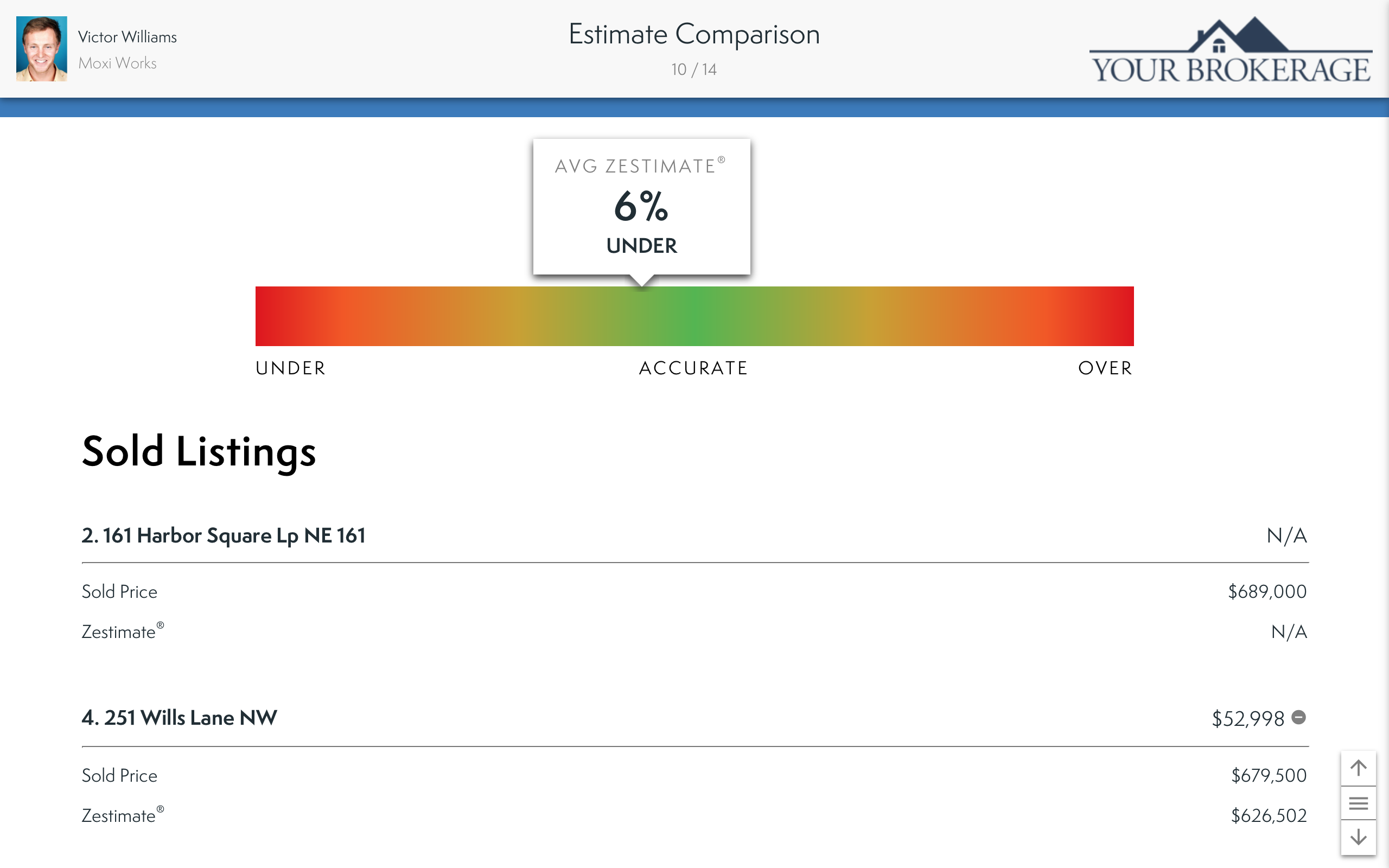
Zestimates. Clients love them, yet they are largely the bane of the real estate business as a whole. In theory, they sound amazing, but the problem is that they’re often horrifically inaccurate, leaving homeowners upset and agents anxious. In fact, the median error rate of Zestimates is 5 percent. That may sound menial as a percentage, but when computed with the median home sales prices, it can be tens of thousands of dollars lost to the bottom line, and that’s if you’re lucky. According to the Washington Post, “Zestimates are within 5 percent of the sale price 53.9 percent of the time, within 10 percent 75.6 percent of the time and within 20 percent 89.7 percent of the time, Zillow claims.” So, unless luck is on your side, that 5 percent is likely to grow.
Wouldn’t it be nice to showcase the Zestimate inaccuracy to your clients?
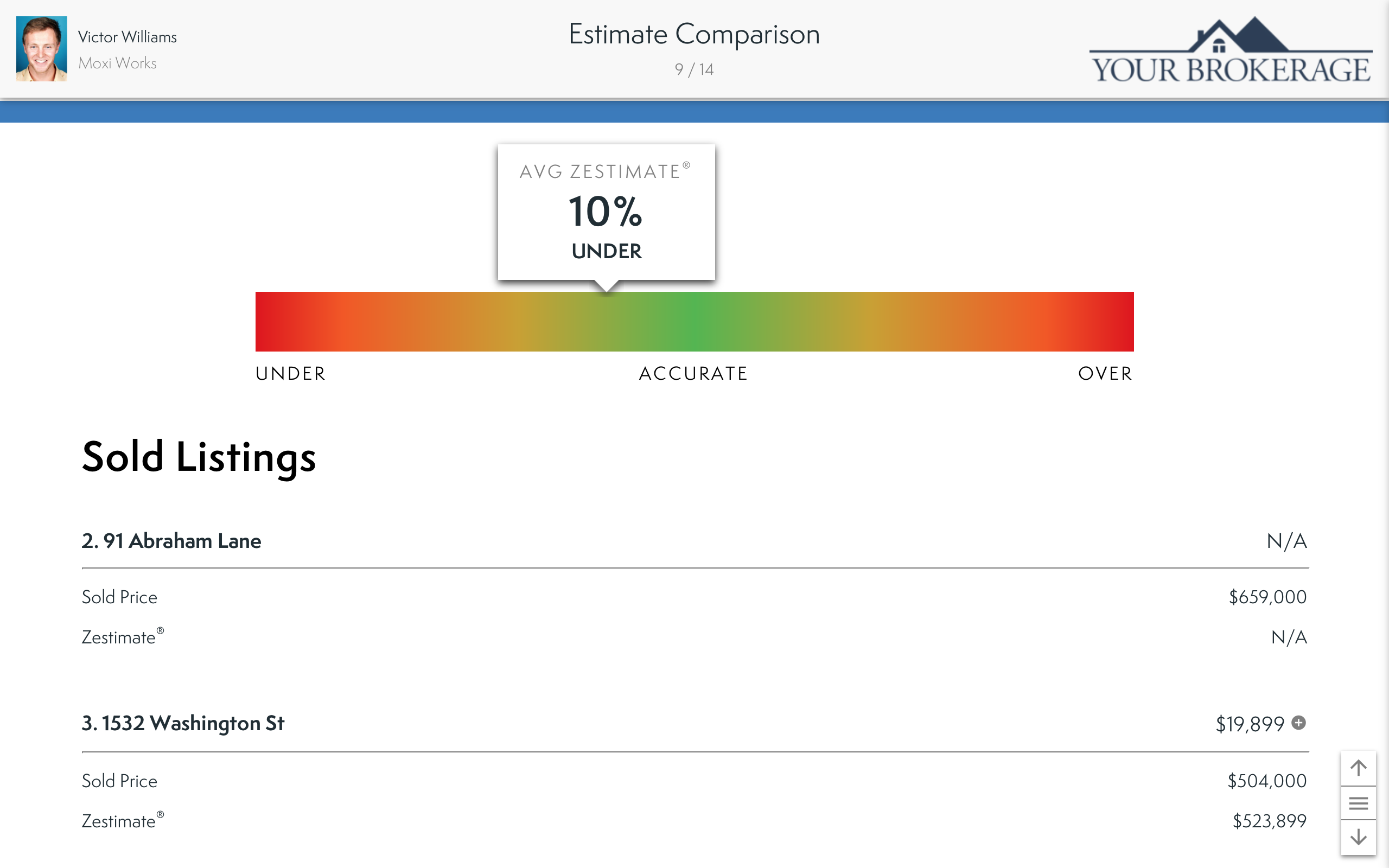
Our CMA presentation tool, Moxi Present, encapsulates the relevant information about a house and enables you, a professional agent, to consult and advise clients with accurate information, and information that can give true context to a Zestimate. It does this by showcasing what the Zestimate was on all selected comparable properties to your current listing versus what they actually sold for. Here is an example of Moxi Present at work.
You are not an algorithm, don’t get treated like one.
Have you ever been sick or not feeling well and tried to look up what your symptoms mean online? If you have, chances are you panicked when the results came up because it eluded to you probably having a horrible flesh-eating disease (even though you just have a flu that’s going around). My point is, when you’re talking about your health, you go see a doctor, a professional doctor. When you’re trying to sell your home, you might take a peek online beforehand, but in the end, you want and need a professional’s advice.
Remember, Zestimates are a computer algorithm. You, the real estate agent, have access to a wealth of data when using modern tools (like Moxi Present) that go well beyond what some computer algorithm is using. You also have access to things that no algorithm can. Let that sink in for a moment. Zestimates can’t see the details of the home’s interior or know the character and culture of a specific neighborhood. As their agent, you are their trusted advisor, the professional.
Find out more about this industry-leading CMA and presentation tool here and why agent’s that used it in 2016 did 43% more business than those that didn’t.
Will Redfin’s Giant Team Take Your Market Share?

By Tiana Baur
Redfin’s stock dropped 5.45 percent last week when Compass announced their plan of world domination. Although, it was primarily due to their poor Q3 earnings release, falling short of analyst estimates, and we’ll go ahead and mention the fact they currently only serve 0.71 percent of the U.S. housing market… BUT they’re still Redfin. They’re still a shark in a sea of minnows, constantly posing a threat.
In real estate, agent teams are becoming kind of a big deal. In fact, there are now 35,000 to 50,000 agent teams across the U.S., with the majority of them having two to nine team members belonging to them. These numbers are only growing, with 37 percent of teams formed one to three years ago and 26 percent of teams formed one year ago.
Working in teams is way more productive and provides additional benefits, such as:
- Extra lead generation
- Process and vision to building a bigger brand and operations that can scale
- Mentoring new agents in the market
- Collaboration and communication through the different roles
- Combining different talents and skills
- A more diversified client demography and audience
What does this have to do with Redfin? Well, they’re basically a GIANT agent team. Instead of having a bunch of independent contractors on their hands, they have agents on staff and have a website that generates lots of leads for their agents. They built a website with tons of cool, shiny technology and features to attract lots of eyeballs and leads. Sometimes, they even give leads to agents at other brokerages, like a team that generates leads and distributes them to their team members.
To quote a popular interview done with an industry influencer this past summer, “Redfin is not a brokerage; it is an agent team. Let that sink in for a moment. Redfin is not in the recruiting and retention business like 99.99% of brokerages are today. They could care less about recruiting the superstar elite agents. Redfin is in the business of helping people buy and sell homes — just like an agent team. They have employee agents who must use Redfin’s systems, must follow Redfin’s procedures, and the people they work with are not their clients, but Redfin’s clients — just like an agent team. And just like an agent team must have a superstar lead-generation lead agent, Redfin has one… in its website and mobile app.”
If you didn’t think of Redfin this way before, now might be a good time to do so. Although they had less than fruitful earnings this quarter, according to GeekWire, they have pushed out a few new products and have a new speedy offer-writing software they’re going to start rolling out in select cities called Redfin Fast Offers. So, who knows what will happen. But a powerful giant like Redfin isn’t going to give up without a fight and your market share is hardly safe in an environment where Compass, Redfin, and others are constantly brewing up their next attack.
