

 Facebook
 X
X
 Pinterest
 Copy Link
A reversion to the mean? — July Home Sales Predictor

It’s nearing the end of July and as I’m sure you’re witnessing every day, the market continues to cool. We’ve been paying close attention to the data and we are still feeling confident that this is just a cooling and a soft landing, and not a screeching halt.
Let’s take a look at the data.
In June, there were 572K home sales, which is 5% more than we predicted. This is the first time in 5 months the number of home sales has been higher than what we predicted. That was 19% fewer homes than were sold in June of 2021, but, as we’ll get into with this month’s data, we still believe this is just a reversion to the mean, and a cooling of the market, not a crash or any reason to panic.
“Looking at the data, nothing is indicating that the sky is falling,” said Ali Rae Lundberg, MoxiWorks Lead Data Scientist

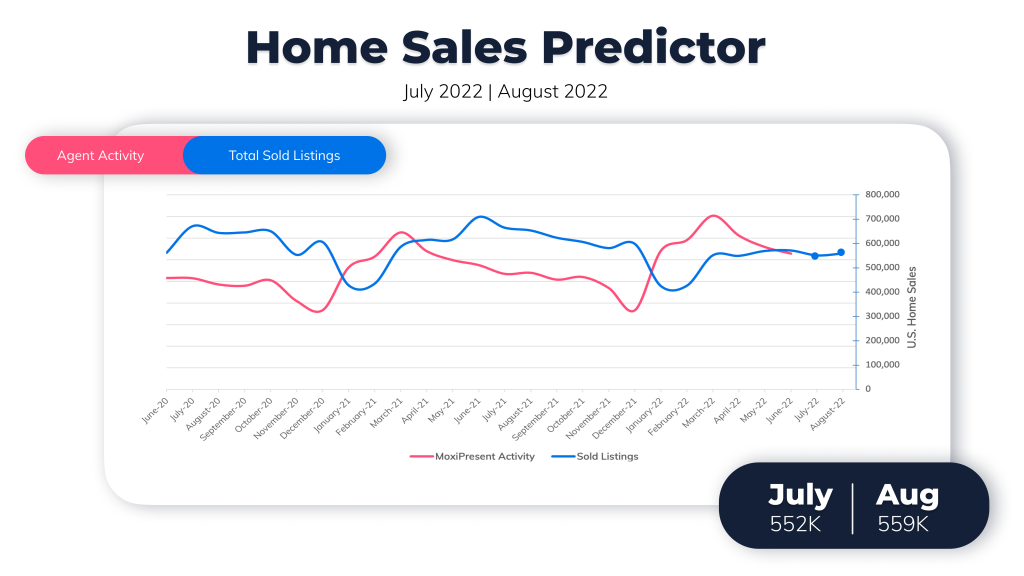
In July we predict there will be 4% less homes sold than in June with 552K homes sold across the US. And finally, in August we expect to see a 1% increase from July with 559K home sales. These numbers we are seeing are bringing us much more in line with the pre-covid seasonality (see chart below for the comparison).
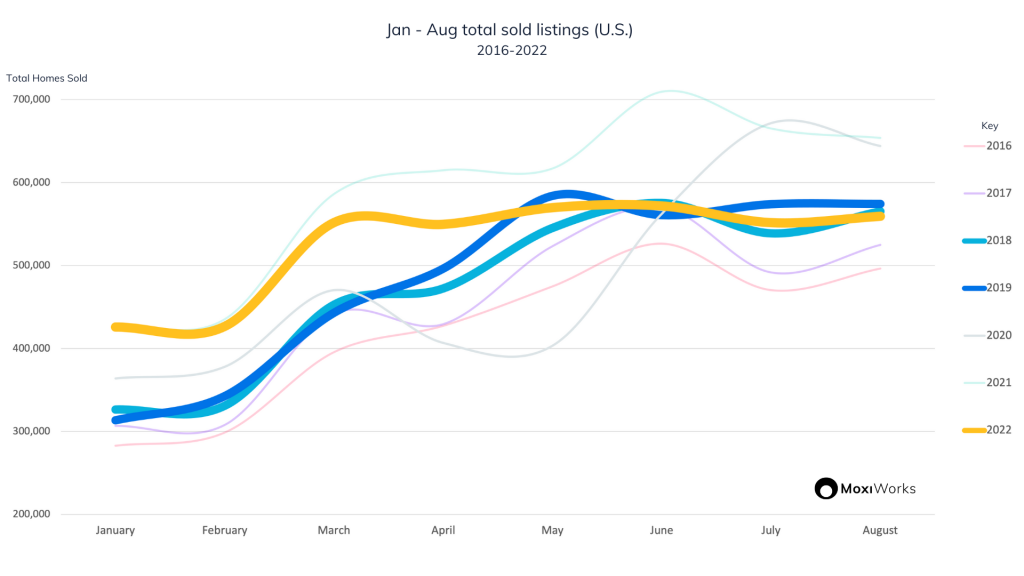
Sold listings 2016-2022 (Jan – Aug). Source: MoxiWorks
Looking at the chart, we are currently hovering right around where we were in 2018/2019 for total number of sold listings in Q3, but still well above 2016/2017. We’ll keep an eye on this, but it’s no surprise to see that we’ve dipped so much for 2020/2021 since those years were the exception not the norm.
“The biggest question that still remains in our minds is if we are the top of inflation & mortgage rate hikes, or if there is a little more to go before we hit that ceiling,” said Cass Herrin, Director of Data Services, MoxiWorks. “The housing market doesn’t like uncertainty just like most markets don’t like uncertainty, but looking at the data there is no need to panic.”

We’ve been saying it for months, but while the national headlines are important to be aware of, what really matters is what’s happening in your local market. That’s what your clients need to be focused on. Remain the expert in your local market. Are prices dropping? Is there more room for negotiation? Help them navigate the climate in their market.
Yes the days of insanely quick sales may be gone, but the market has not dried up and people still need to buy and sell their homes. Stick to your fundamentals. Be the expert and you will make it through this cooling period and come out better on the other side.
See you next month!
The Home Sales Predictor is a set of prediction data that dives into the number of presentations created and the correlated number of U.S. home sales. This data is provided by MoxiWorks with insights from their MoxiPresent product.
Get our Home Sales Predictor Monthly Report delivered to your inbox!
MoxiWorks Announces New Homeownership Portal Aimed to Help Real Estate Professionals Boost Loyalty and Win Customers for Life

The portal will empower agents to stay in flow with clients throughout the entirety of their homeownership lifecycle with real-time guidance, relevant advice, and local resources; curated by each brokerage and personalized by agents
SEATTLE, WA (May 4, 2022) — MoxiWorks, the real estate industry’s leading technology platform for real estate brokerages, announced today a homeownership portal that will complement their robust suite of solutions to help brokers and their agents sell more homes. The portal will be a one-stop shop for homeowners.
Real estate professionals will be able to guide their clients to buy, sell, move and manage their home throughout the lifetime of their homeownership. This will include dedicated transaction portals where a buyer or seller can collaborate with their real estate agent, mortgage broker, insurance agent, and anyone else supporting the transaction process. The portal will also connect directly to a brokerage’s existing tech stack and is designed to provide a comprehensive and personalized customer experience throughout the transaction and homeownership journey for everyone involved.
“We built the MoxiWorks suite of products around sphere methodology,” said York Baur, MoxiWorks CEO. “The power of your sphere over cold leads is unmatched. The industry has been asking for a one-stop-shop and we’re excited to create something that will make it easy, automated, and accessible for both the real estate professionals using it as well as their clients.”
With the MoxiWorks homeownership portal, agents can collaborate with clients in a personalized space and connect them with other expert resources in their communities like loan officers, inspectors, or other services.
“This offering not only preserves the relationships between brokers and agents, and agents and clients, but it also helps maintain those relationships at scale,” said Baur. “The average real estate agent on MoxiWorks’ platform has 400 relationships they continuously nurture. Being able to have close, personalized interactions with that many contacts, over the lifetime of homeownership, will be a game-changer.”
The homeowner portal will be powered by Milestones Labs, a pioneer in digital customer experience. This portal will bring together a team of experts, from brokers and agents to ancillary services like title and mortgage. These custom portals are tailored specifically to the customer and nudge them through the necessary tasks while eliminating all the noise from others in our industry. A portal can be automatically spun up for a buyer client, sellers, or just contacts wanting to maintain their property for the long haul.
“We are thrilled to partner with MoxiWorks to serve the evolving needs of the real estate community,” said Dustin Gray, Milestones CEO. “MoxiWorks has a proven track record delivering powerful technology at scale while remaining steadfast in its mission to help industry professionals thrive. Together, we will help brokerages serve the next generation of homeowners – by leveraging technology to deliver personalized client service before, during, and after the transaction.”
To learn more and join the waitlist, visit moxiworks.com.
About MoxiWorks
MoxiWorks is a comprehensive open platform system for residential real estate brokerages that serves over 800 brokerages and 400,000 agents nationwide, accounting for more than 20% of the transactions in the U.S. MoxiWorks’ customer retention over the past seven years stands proudly at 97%. Their integrated tools are centered on sphere methodology that increases agents’ repeat and referral business by 54% while lowering overall technology, training, and support costs for the brokerage. The open platform known as the MoxiCloud has tools from more than 150 partners that integrate to create unique brokerage solutions.
MoxiWorks – Let’s sell more homes together
###
Home Sales Predictor – April showers bring May flowers
It feels like every day there are contradictory reports in the media about the current housing market.
‘It’s too hot, the bubble’s going to burst’
‘The market’s cooling, but prices are high’
‘Inventory is up’
‘Inventory is still synched’
Which way is up? It likely depends on your market. But this continued uncertainty is exhausting consumers. According to Fannie Mae’s March edition of their Home Purchase Sentiment Index® (HPSI), “Only 24% of consumers think now is a good time to buy a home — the lowest reading ever recorded in a monthly survey conducted by Fannie Mae since 2010.” Additionally, according to the survey, “73 percent of Americans think the economy is on the wrong track.”
On the other hand, a Redfin survey from February said 1 in 3 people were looking to relocate. So which is it? Are people moving or staying put?
Only time will tell what actions our will clients take, but based on our data, we predict home sales will slow from what we’ve been used to over the last two years, but even that pessimistic attitude reported of buyers won’t stop the continued sales.
The Home Sales Predictor
Here’s a look at our most recent data:
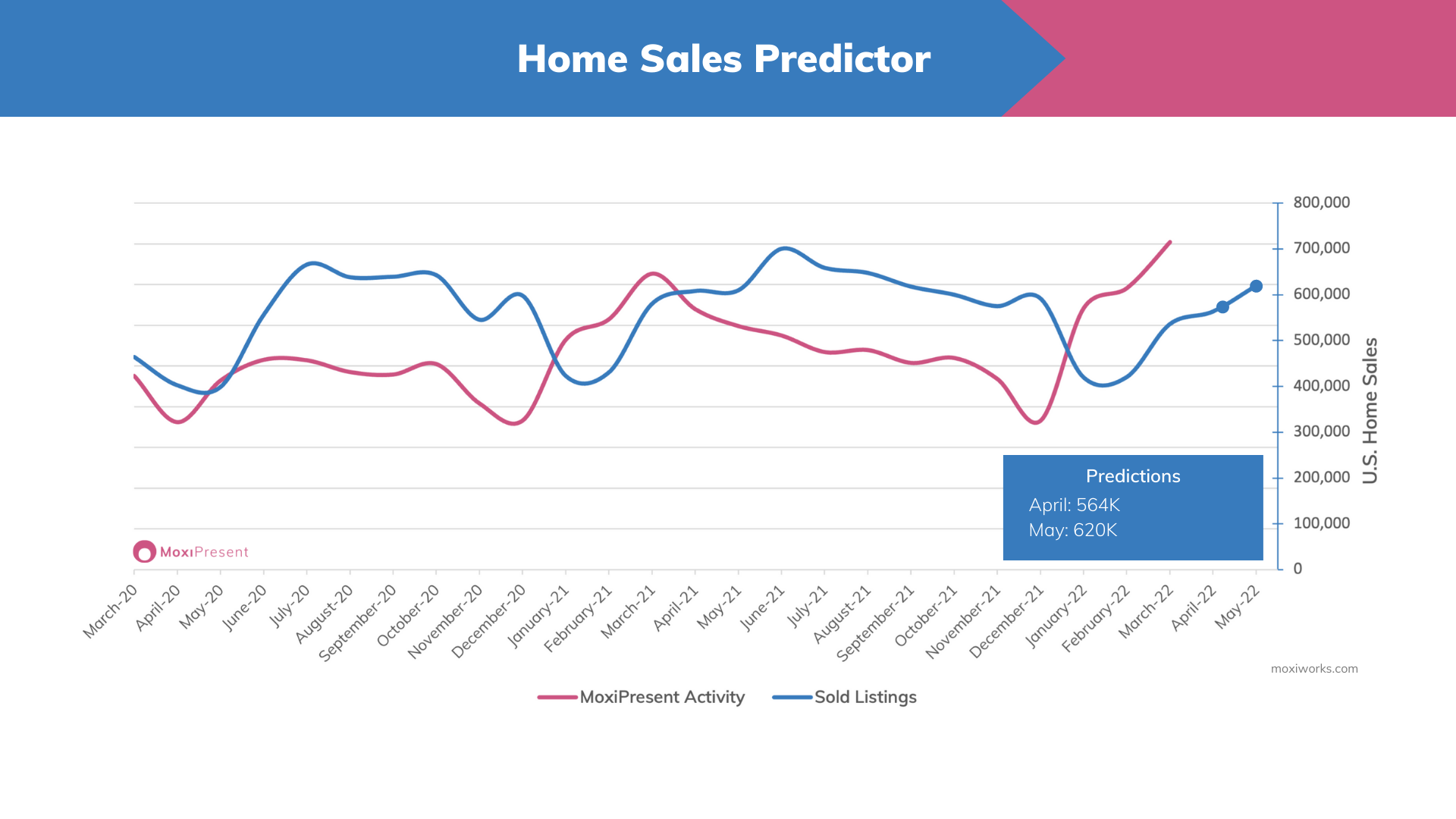
Our March prediction was just 1% off with 536K home sales. That was a 28% increase in home sales from February, but a 6% decrease year-over-year.
Based on the activity of agents in our products we predict there will be a 5% increase from March 564K home sales in April and then another 10% increase in May with 620K home sales. That’s a 7% decrease year over year for April, but a 2% increase YOY for May.
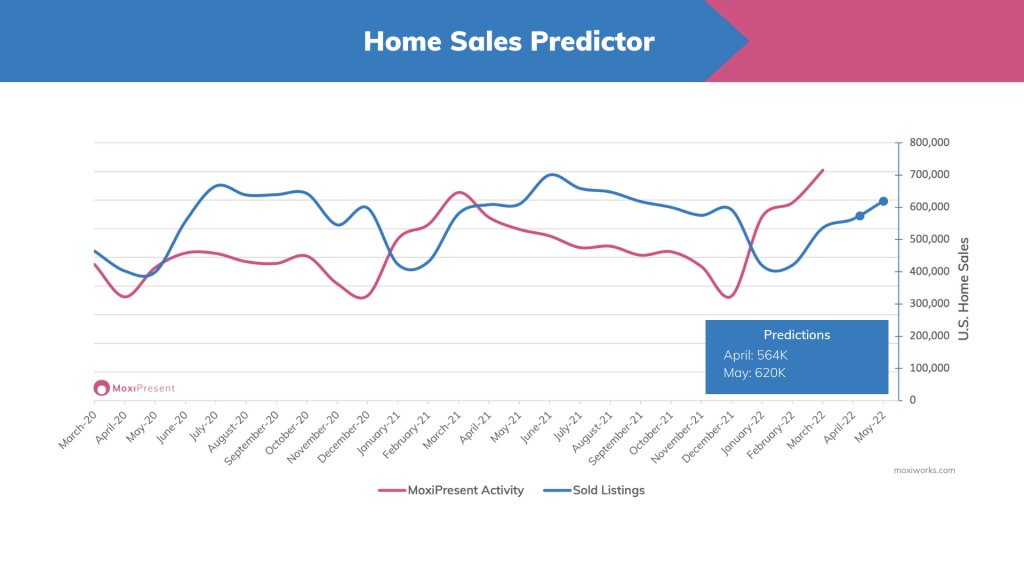
So while the market may be cooling compared to 2020/2021 standards we are still expecting to see 620K home sales next month which means it’s not cooling down all that much, at least not yet.
We of course know that continued inflation and interest rate hikes are going to impact the market, time will tell how much.
At the end of the day, homes are still going to be bought and sold. The question really lies in whether or not the market will stabilize enough for it to become affordable again for first time homebuyers to enter the market. Or, if the barrier to entry will continue to get tighter. It’s Fair Housing Month which means this is a great time to take a step back and see how you are helping your community. NAR has a ton of resources to help you assess and see what more you can do to help combat the barrier to entry.
The dream of homeownership should be able to belong to anyone. As brokers and agents you have the power to help make those dreams come true. You also have the most insight into how your market is performing and how your buyers and sellers can get the most bang for their buck. Make sure your systems and processes are top notch in order to help your clients make the right decision for their market.
The Home Sales Predictor is a set of prediction data that dives into the number of presentations created and the correlated number of U.S. home sales. This data is provided by MoxiWorks with insights from their MoxiPresent product.
Get our Home Sales Predictor Monthly Report delivered to your inbox!
Strong year of home sales on the horizon in 2022
As we close out 2021, hopefully with our loved ones, we are taking one final look back at home sales for this year before we turn the calendar and embark on the next chapter in our industry.
2021
2021 took us on a wild ride as we got a peek at the possibility of new seasonality trends. It was also proof that people’s need for a great home to live their lives, raise their family, and now work, is resilient against almost all other things.
Since October we’ve also been predicting that we will see 6.8 million home sales this year. The last time we saw a year of higher home sales was back in 2005. It’s almost hard to believe after a year of non-stop talk about inventory shortages that the result will be a historic number of transactions.
So what does all of this mean for 2022? First, let’s take our last look at 2021.
November 2021
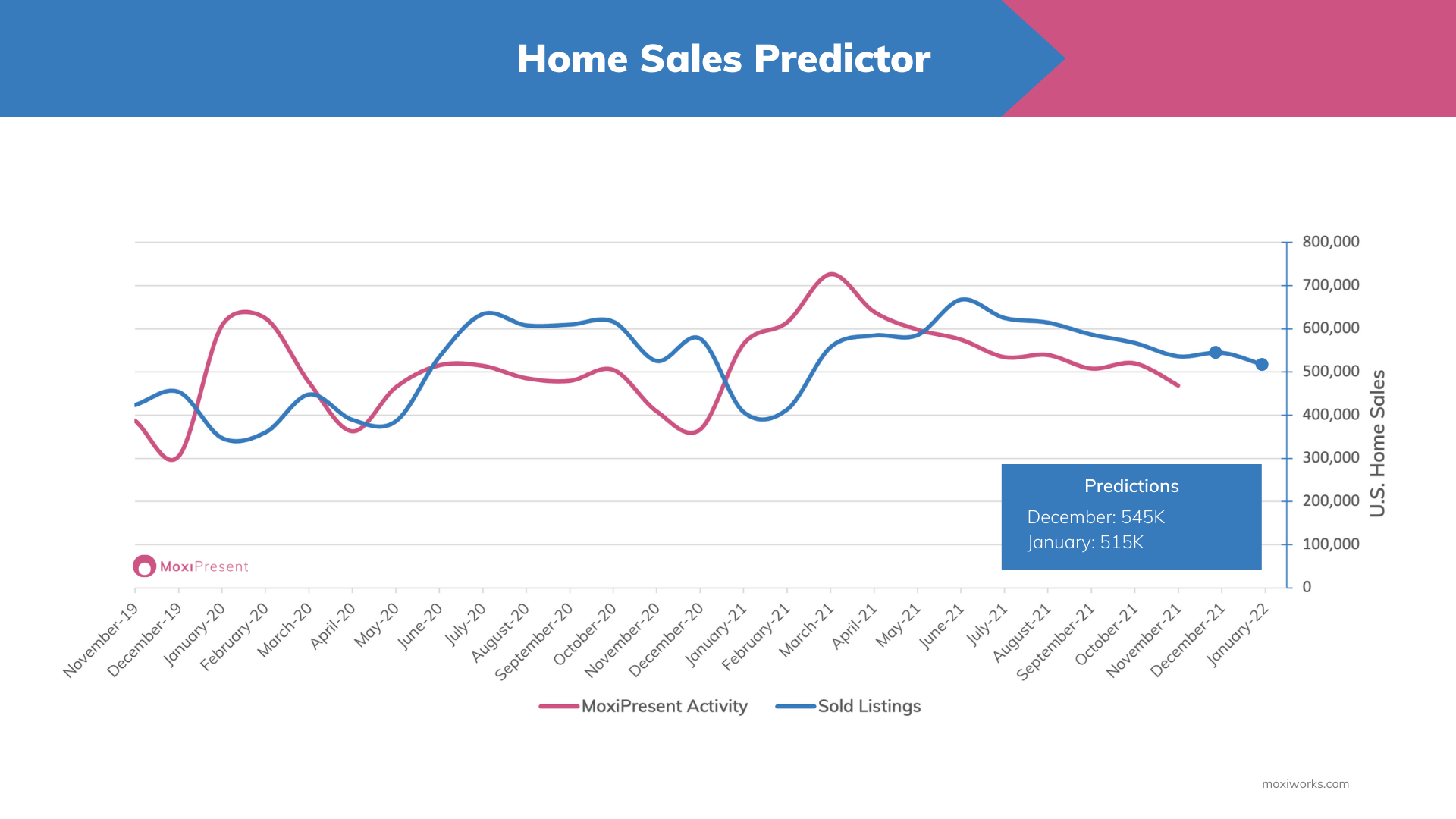
In November, there were 536K home sales, which was 4% more than we predicted. The result was a 6% decrease in sales from October, but a 2% increase year over year. While we historically see a 2% increase YOY as we saw in 2018 and 2019, in 2020 there was a 24% increase YOY, which means November stayed a hot month even not in the height of a pandemic.
December & January
In this final month of 2021, we predict there will be 545K home sales in December which would be a 2% increase from November. In January we predict we will start the year strong with 515K home sales, which would be a 5% decrease from December, but a 27% increase year over year.
Ringing in 2022
As we look ahead to 2022 there are a number of things to consider that will impact transactions. One of the main areas we are paying attention to is inflation, and specifically wage inflation.
As home price decelerates, wage inflation will likely increase affordability therefore causing another strong year of transactions across the country. That’s not to say that all markets will be affordable, but the wage inflation (arguably caused by corporations like Amazon setting the new standard for wages) will have an impact on new homebuyers coming on the market especially in more affordable communities.
Something else that will likely impact the rate of home sales is the Great Resignation. Coldwell Banker recently released a study that revealed the impact the Great Resignation will have on the housing market, particularly in more affordable areas of the country. Around the country workers have indicated they would take a pay decrease in order to live in a more affordable area of the country. So what will that mean for inventory and transactions?
Ultimately, we predict with the deceleration of home prices, wage inflation, and for the foreseeable future, continued low-interest rates, 2022 could be another record-breaking year for home sales.
What role do you play?
As more and more ways to buy and sell homes emerge on the market, one thing remains true – buyers and sellers need a trusted advisor. The most recent data from NAR in 2020 stated that “87% of buyers recently purchased their home through a real estate agent or broker” (source). That means 87% of home sales are dependent on all of you.
Continue to nurture your sphere. Be the first person someone thinks of when they are ready to buy or sell, or, even before they are ready. You have the power to make a difference for your clients, your community, and the industry as a whole.
See you in 2022!
The Home Sales Predictor is a set of prediction data that dives into the number of presentations created and the correlated number of U.S. home sales. This data is provided by MoxiWorks with insights from their MoxiPresent product.
Get our Home Sales Predictor Monthly Report delivered to your inbox!
What Seasonality? Home Sales Hold Strong
Summer is winding down in many parts of the country. Kids are going back to school while professionals head back to the daily grind. One thing not winding down? Home sales.
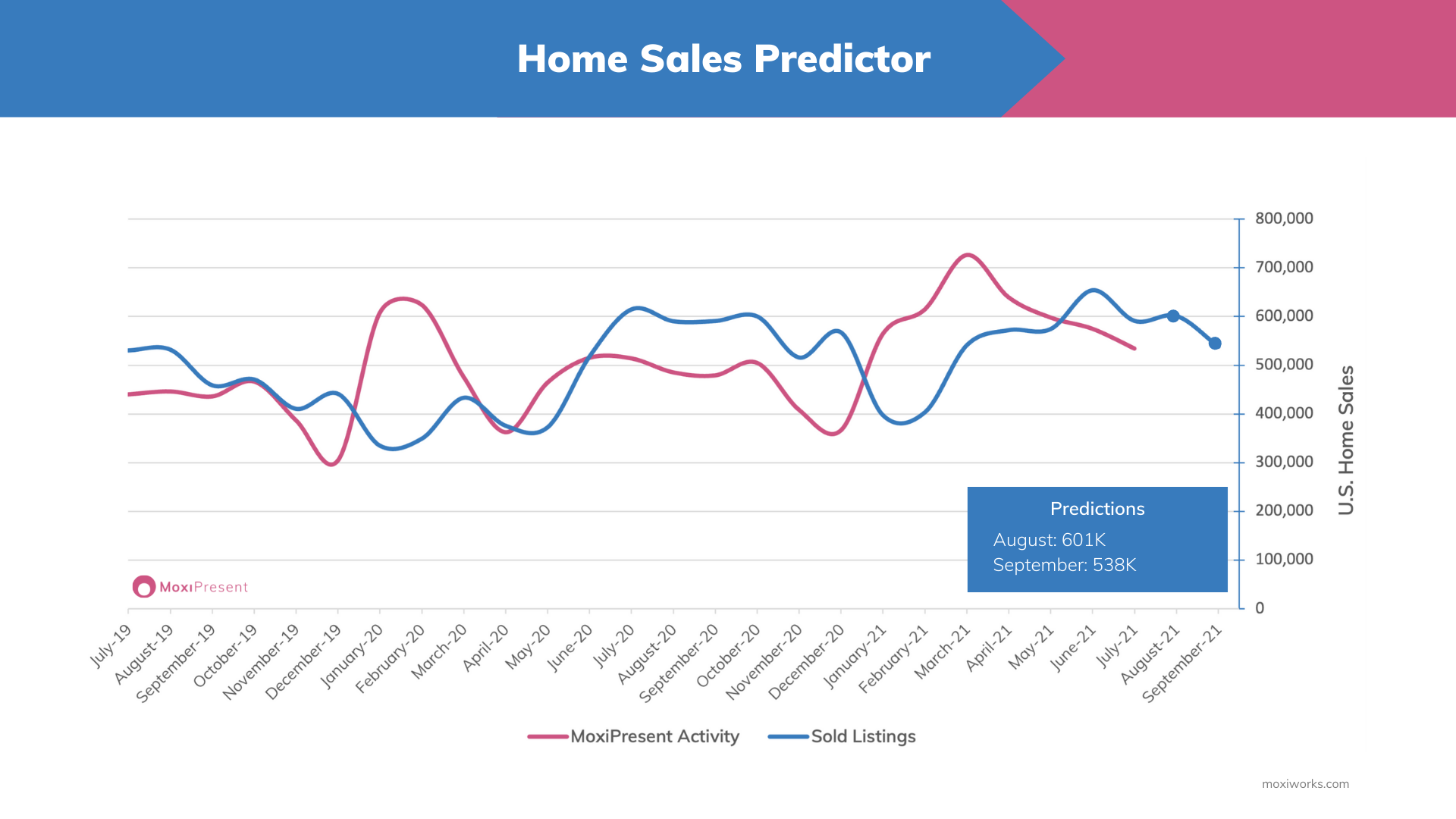
There were nearly 600K homes sold in July with 591K home sales, meaning our prediction was within 1%. While that is a 10% decrease in home sales from June to July and a 4% decrease YOY that is still a very strong month of home sales and it looks like it should stay steady over the next few months, really just throwing our usual seasonality for a loop.
So, what’s ahead for August and September?
Predictions
Based on activity inside our MoxiWorks products we predict there will be a 2% increase in home sales in August with 601K homes sold followed by a 10% decrease in September with 538K home sales.
While that would mean a 9% decrease for September YOY, when comparing it to a more normal year like 2018 or 2019 that’s a 27% and 17% increase respectively for this time of year which definitely points to this wonky year of home sales continuing.
So, what about home prices?
The big thing we’ve been talking about around the virtual MoxiWorks lunch table this past month is less about the waning inventory (even though that is of course still a concern) and more about current home prices and interest rates. Interest rates are still at a record low, but, at some point, they will start to increase again as economic principles come into play. Until that happens this will remain a seller’s market with record breaking home prices that are spooking buyers. Because these buyers are spooked another thing we are keeping our eye on is the increase in non-traditional home buying, i.e. iBuyers. Needless to say, there’s a lot happening and it will be interesting to see what these changes mean in the coming months. So how can you and your agents be ready?
Fall & Covid-19
We are of course not ignoring the Delta variant and what that might mean for the Fall and Winter months of home sales, but for now, our message remains the same. Protect yourself and your agents from whatever is coming our way by staying in flow with your sphere. Keep working for your future by staying in flow with your sphere now. If the last 16 months have taught us anything it’s that things can change at a breakneck pace and you don’t want to be left wishing you had kept your book of business fresh, nurtured and full of your future leads.
Until next month.
Hot housing market, with no indication of a cool down, for now.
In last month’s Home Sales Predictor article we said –
“Only time will tell if this flattening trend will continue or if we will see a spike later this year. Many of our clients have shared with us they are starting to see more listings in their area so maybe we will still see a spike? What trends are you seeing? Do you think we’ve seen the peak?”
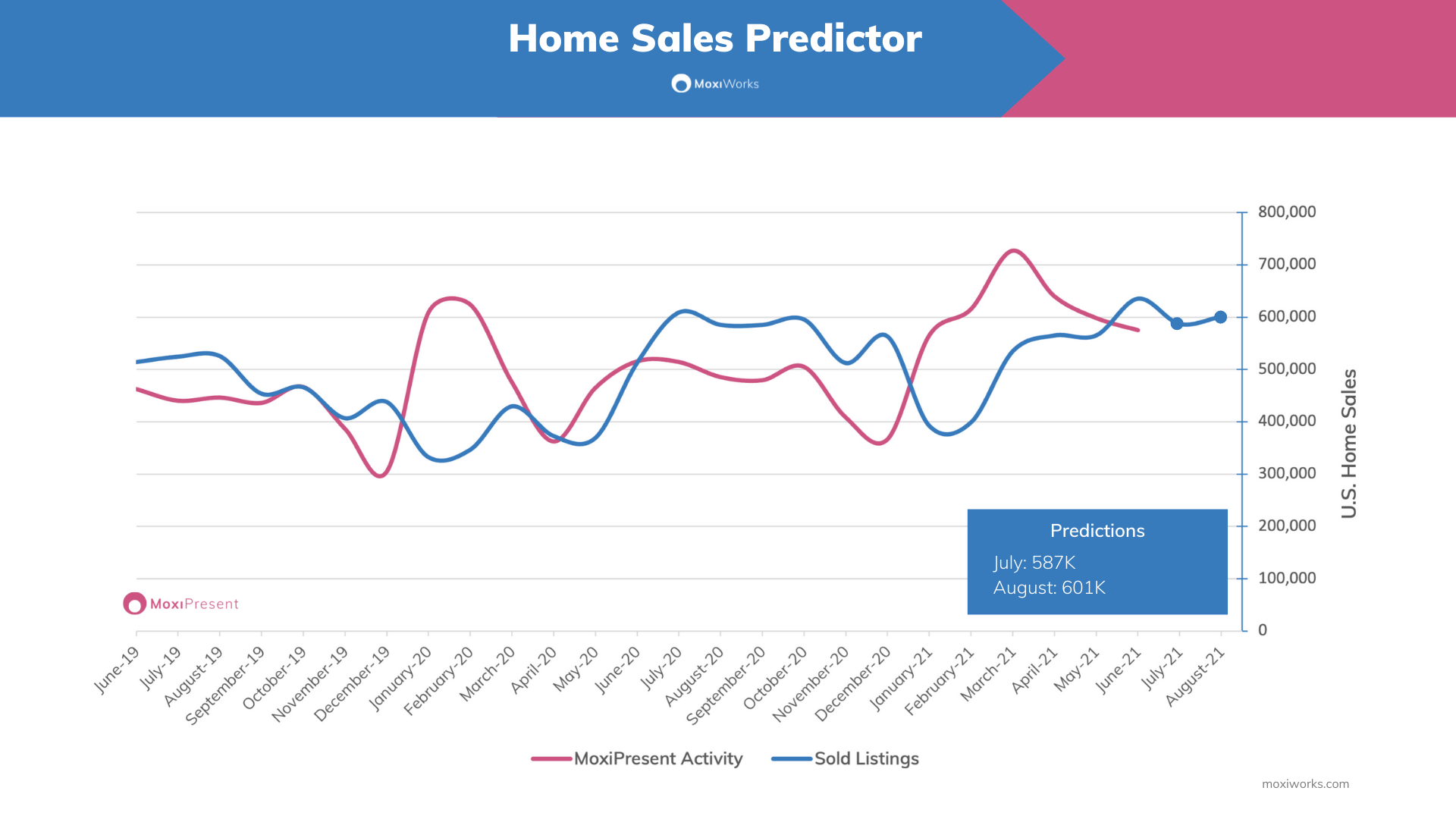
And, it appears the flattening has not happened yet. In June there were a record-breaking 636K homes sold across the US. That’s 6% higher than our prediction and 24% higher year-over-year. In fact, that is the most homes sold in a month that we have seen since we started tracking this data back in 2016.
July/August Predictions
Looking ahead it appears the market will remain hot with a brief slow down expected for July (which is a historical trend) with 587K home sales. That would be an 8% decrease from June and a 4% decrease YOY. We then expect the market to pick right back up to 601K in August. If our prediction holds true that would be a 2% increase from July and a 3% increase YOY.
When talking with our data team this month about the Home Sales Predictor one thing we all agreed on was the fact that this is a weird housing market that really feels like the tip of a lot of interesting things happening in the world right now.
Especially for us here in the Pacific Northwest. We’ve been living in a market that was mostly closed for the last 15 months, it’s been shocking to see how much has changed in the last two. And, especially in the housing market. A lot has been unpredictable and while we are confident in the data at our fingertips, time will only tell how much wackier this market may get.
Institutions vs. Homebuyers
Things are starting to look up in the economy as we return to work, travel and entertainment. There are even signs things may change for the better in terms of the housing inventory as lumber prices start to stabilize and housing starts will finally be reviving, but we still have an uphill battle to climb as more and more millennials aim to get into the homeownership game.
One of the biggest things at play that we are focusing in on is how much institutional buying is putting pressure on the already shrinking existing home inventory. We’ve been talking for months about the listings shortage vs. inventory shortage, but new data is causing us to take another look when an already pressured consumer market is seeing more pressure from the resurgence of the iBuyers (more on that below) and this further immergence of the institutional buyers that are buying homes and taking them off the market by turning them into rentals.
According to a recent Redfin report investors spent a record $77 billion on homes over the past six months compared to the $55 billion that was spent in the second and third quarters of 2020. That’s 1 of every 7 U.S. homes in the first quarter where in the previous three quarters investor bought closer to 1 in 10 homes (Source: HousingWire).
That same report shared that “Most [investors] focused on single-family homes, which made up the biggest share of acquisitions and first-quarter growth, year over year. Nearly 39,000 of the 55,000 homes investors bought in Q1 were single-family properties, up 4.8% from last year” and that among those buyers were Invitation Homes and American Homes 4 Rent, both “single-family-rental behemoths.” (source: The Real Deal)
So while concerns have been flying around about the resurgence of iBuyers it’s important to note that iBuyers are still only roughly 50% of the way back to their pre-pandemic levels with only 4,383 homes purchased in Q1 of 2021 and only account for 0.5% of homes sold across the U.S. making them nowhere near an immediate threat to our housing shortage.
What does the future hold?
The market will likely continue at this velocity, but the concerns around intuitional buyers squeezing our inventory opportunities will remain top of mind. Especially for how it can disproportionately impact the lower and middle class and especially for minorities who oftentimes lack the generational wealth to get their foot in the door, especially in a crazy market like this one.
And it’s not a great sign when, according to HousingWire “investors gobbled up the largest share of lower-priced homes in the first quarter…One of every five low-priced homes that sold in the U.S. (20.8%) was purchased by an investor, compared to 12.5% of high-priced homes and 11.3% of mid-priced homes.”
So, what can you do?
Use your power as a real estate professional to help overrepresent the underrepresented. Try and focus on building your sphere with families to help get them into homes and start building wealth and generating more opportunities for future growth. The more we can build diverse communities the better for society and the better for our future as an industry. Look for the opportunities to make positive change in your community while making sure all the homes on our street aren’t bought up by investors. Be that valuable resource for all of your contacts in your sphere and educate them on the benefits of buying and selling a home in their market to help continue to foster movement and transactions across the industry.
Sources:
- https://therealdeal.com/2021/05/21/institutional-buyers-are-flooding-single-family-market/
- https://www.housingwire.com/articles/investors-are-buying-up-single-family-homes-across-the-us/
- https://www.redfin.com/news/ibuyer-real-estate-q1-2021/
- https://www.vox.com/recode/22407667/home-sales-boom-rent-housing-single-family-rental
- https://www.wsj.com/articles/lumber-prices-are-way-downbut-dont-expect-new-houses-to-cost-less-11626260401
The Home Sales Predictor is a brand-new set of prediction data that dives into the number of presentations created and the correlated number of U.S. home sales. This data is provided by MoxiWorks with insights from their MoxiPresent product.
Get our Home Sales Predictor Monthly Report delivered to your inbox!
MoxiWorks Announces New Scheduling Tool Partner through Instashowing Bringing Agents a Fast and Effective Solution

Agents gain access to Instashowing’s platform making it easier than ever before to schedule and manage showings
Key Takeaways:
- MoxiWorks’ new partnership with Instashowing brings its users direct access to Instashowing’s listing appointment scheduling platform.
- The new partnership will make Instashowing’s platform available to MoxiWork’s 400,000+ users.
- Access to Instashowing will streamline scheduling, allowing agents to focus more on thriving in today’s red hot market.
(Seattle, WA) – MoxiWorks, the leading real estate technology platform, announced today a new partnership with Instashowing, a technology platform specializing in listing appointment scheduling. This partnership will centralize key parts of the listing agent workflow in MoxiWorks platform and will be in effect and available to MoxiWorks’ 400,000 users as of June 16, 2021.
“Showings are a critical part of a listing agent’s business and bringing this product inside agent’s favorite platforms such as MoxiWorks will make the entire experience seamless,” said William Schoeffler, Founder of Instashowing. “The best agents have used multiple apps to manage their business and we’re excited to see the deeper integrations making agents’ lives more seamless. We were attracted to the open platform approach MoxiWorks stands for and this is exactly what we are doing with our open showing API.”
Through this new partnership, MoxiWorks users will gain access to Instashowing’s unique platform that will be automatically available when a user creates a new listing. Seller’s agents will be able to add their sellers to a portal so they can control when their home is shown and get property feedback directly. Additionally, both the agents and seller can conveniently manage the appointments and available times within their calendar.
This partnership will empower agents to capture more leads from qualified prospects as they book showings on agent and brokerage websites.
“The MoxiWorks team is excited to partner with Instashowing and to give our users access to their platform. This partnership will streamline the scheduling process for our users, cutting the time usually spent on scheduling in half,” says Krista Thomsen, MoxiWorks’ Senior Manager, Partnerships & Integrations. “By offering our users a tool to make scheduling easier, they will have more time to focus on helping home shoppers in today’s competitive market.”
To learn more about this integration and how it can benefit your business, visit moxiworks.com and Instashowing.com.
About Instashowing
Instashowing is a technology platform specializing in listing appointment scheduling that simplifies the scheduling process for agents. Founded in 2018, this online real estate tool is designed to help agents easily schedule home showings. Instashowing has made the booking process easier and more integrated with the platforms agents are currently using. Find more information at instashowing.com.
About MoxiWorks
MoxiWorks is a comprehensive open platform system for large residential real estate brokerages that serves over 800 brokerages and more than 400,000 agents nationwide that account for more than 20% of the transactions in the U.S. MoxiWorks’ customer retention over the past seven years stands proudly at 96%. Their integrated tools are centered on sphere methodology that increases agents’ repeat and referral business by 54%, while lowering overall technology, training, and support costs for the brokerage. The open platform known as the MoxiCloud has tools from more than 100 partners that integrate to create unique brokerage solutions. Find more information at moxiworks.com.
MoxiWorks – Let’s sell more homes together
###
For more information on this topic and other press inquiries at MoxiWorks, please contact Jordan Barrish at Jordan.barrish@moxiworks.com.
Pocket Listings: What You Need to Know

By Jessie Trapp, Marketing Coordinator
It’s a cut-throat market out there. Inventory seems to become increasingly scarce by the day, and sellers continue to hold tight to their reign as the power players of the real estate world. With agents scrambling to find a competitive edge, it’s no surprise that some of the tactics being used are stirring up serious controversy within the industry.
Enter: pocket listings. The actual usage of the term “pocket listing” can be somewhat confusing, as it is often used to describe multiple types of property listings that agents have different intentions for. Put simply, a pocket listing is a signed property that an agent has acquired but hasn’t listed on the MLS (Multiple Listing Service). In some cases, the agent intends to list it but simply hasn’t yet, however, for the most part it means that they have a property and intend to sell it to someone in their sphere without ever even placing it on the MLS at all. If you haven’t already, now is the perfect time to put this method on your radar because the secrets out – and clients are asking about it.
The topic of pocket listings is a fiery one among agents because it tends to walk on a fine line between tactical and, arguably, unethical. Agents are, in compliance with the Code of Ethics, required to do everything in their power to ensure that they get the best offer for their client. Those against the practice claim that withholding a pocket listing from the MLS presents the risk of missing out on higher offers that could result from making it accessible to the general public, therefore failing to act in the best interest of the client. Transactions for pocket listings also generally remain in the hands of the listing agent, as they often represent the both the seller and the buyer. Some opposed to the practice also express concern that some agents are too biased in favor of it due to the potentially higher commission in it for them, and fear that clients might not always be well educated on the ramifications associated with the practice.
Although these risks likely account for why pocket listings are usually not considered to be the standard practice in real estate, sellers occasionally prefer it and it has the potential to give agents a notable advantage. Not only can the limited exposure component of the method offer a more private experience for the seller, but it can also simplify the offer process all together and speed up the transaction time. For sellers who are wanting a quick sell, this aspect can be a major incentive to sell their home as a pocket listing. By avoiding listing a property on the MLS you lower the amount of wide spread interest and walk-throughs but, in the right situation, you can also increase the quality and seriousness of the interest received. This brings it back to the agent- because pocket listings take the MLS exposure out of the equation, the quality and health of your CRM and overall sphere plays a major role in how successful you can actually be with this strategy. Not sure if your sphere is up to par? Take a look at this piece we wrote to help you gauge where you stand.
Buyers also occasionally prefer to make offers on pocket properties because less competition means that they are more likely to avoid the grueling bidding war process. Again, depending on the situation this can be negative for both buyers and sellers, but some continue to prefer its more simplistic approach and pursue it anyway. For the sake of transparency, some in the industry feel as though agents should always present pocket listings as an option on the table for their clients. This could be risky for both the client and the agent if handled improperly. As the agent, it’s your responsibility to make sure you’re practicing within the laws, which vary among states, and making the pros and cons associated with the method abundantly clear so that sellers can make informed decisions and you can cover yourself against any potential violations.
Like I said, this topic is complex, and people are all over the board in relation to how they feel about it. The practice is very unregulated, meaning there aren’t reliable statistics reflecting how many agents are actually engaging in it. It does, however, seem safe to say that it’s usage is significant considering tech companies, like this one, are viewing it as an opportunity to create a structured platform for it. Regardless of whether you believe this approach to be an epidemic or a tool, it’s important to analyze its effect on the market from all angles because let’s face it- you’re bound to run into it eventually, and you’re going to want backup.
To Worry or Not to Worry: Blockchain’s Role in Real Estate

By Tiana Baur, Content Marketing Manager
Blockchain, Bitcoin, cryptocurrencies…what’s the difference? Why does it matter? What does it mean for our future? It feels like the topic of the year regardless of the industry you’re in. Earlier in the year we wrote an article on cryptocurrencies in the real estate world; buying homes and paying rent with digital currency. While some are splitting up a transaction to use some cryptocurrencies, others are doing the entire transaction via cryptocurrency. There’s even a “Blockchain real estate platform” called ShelterZoom that just announced their application is live in over 10 states.
It’s all happening very quickly, but it’s important to make sure we’re all caught up on the basics. Let’s start here:
Cryptocurrency: Digital currency, exchanged and traded over the internet. They’re designed to create a more secure route for trading, and more secure documentation of who traded what, when.
Bitcoin: A decentralized cryptocurrency, that works without a central bank, allowing for less restrictions. It’s the most well-known cryptocurrency.
Blockchain: The network and ecosystem in which bitcoin sends and transfers money on. It’s the foundation that powers Bitcoin and the other cryptocurrencies.
The gist, is that this network is public and can be used to transact anywhere in the world without a bank or “middleman.” It’s also cheaper to do the transaction on Blockchain compared to the traditional way. Our favorite way description of how it all works:
“Imagine that you and your best friend Bob are standing on a stage in an auditorium, and there are 1,000 people in the audience. In front of these 1,000 people, you hand your car keys to Bob, and Bob hands you his Rolex. You declare, “Bob, you now own my car.”
Bob declares back to you, “You now own my Rolex.” There are 1,000 witnesses who can each declare, without doubt, that your car now belongs to Bob, and the Rolex belongs to you. If anyone in the audience later tells a conflicting account of who owns the car or the Rolex, the other 999 people will refute it. And, if you take a spare set of your keys and try to give that same car to someone else, the 1,000 audience members will confirm that Bob owns the car, as each of them witnessed the “transaction.”’ (Forbes, 2018)
While some may say they don’t feel comfortable using Bitcoin or other cryptocurrencies, or don’t trust the network Blockchain itself, others will swear by its innovation in security. The thing is, if you buy a house with bitcoin, you’re technically still buying it in cash, it’s just being converted into a cryptocurrency first. So, how will Blockchain affect the industry as we know it?
Buying/Selling
Before you write it off, real estate transactions could get a whole lot easier. Not only that, but they could get a lot more secure as well. With accurate data and efficiency as its strengths, Blockchain will eliminate the need for a third party; no more waiting for bank wires and checks to clear. On Blockchain, every user has a unique identity via cryptocurrency, meaning financial info can be shared securely to other parties, making the Escrow process a walk in the park.
MLS
As we all know, the MLSs across the nation are tremendously scattered and fragmented. Each one has different restrictions, making it hard to compare data and find trends. While others in the industry, such as Upstream, are trying to solve this issue, Blockchain technology could be the single point of truth that fixes the MLS problem. Secure, nationwide data, with real-time access to property information, what’s not to love?
Records
Titles can be hard to access. Blockchain is starting to change this, with its ability to be a record-keeper for any kind of transaction out there. Smart contracts, personal records and credit history, trademarks, elections, titles – you name it. That means it could also provide a central database for all property titles, saying goodbye to paper titles for good.
In the future where Blockchain rules the land, real estate professionals will actually thrive in it. This technology will only improve the industry and lives of those in it; it’s not a technology you need to be afraid of. We say, learn as much as you can on the topic, stay up-to-date, and get involved hands-on as early as you can. For every one person who is against a decentralized currency, there are two more who are about to hop on the bandwagon.
Robot real estate agents, bitcoin, and VR in 2018

By Tiana Baur
The next time you purchase a car, it very well might be a self-driving one. It’s a headline our eyes now only glance at because we’ve seen it so many times and it’s only a matter of time before it comes to fruition. We’re not only okay with that technology, we’re jazzed about it. We’ll all be able to work, read, and relax during our commutes and trust that we’ll get to our destination timely and in one piece. There’s foreshadowing of another technology too. One that would not only upset our industry, but would tear it to pieces, and that’s the tease of robots as real estate agents. It’s a viable conjecture, especially given how technology is now paving the way for the future of our industry. The problem is, the home buying journey has a very different barrier to trust and breaking down that wall will be close to impossible.
People got their heads out of the sand (some didn’t) and we’ve seen rapid change in the past couple of years. VR (virtual reality) tours are a “thing” homebuyers now expect when they’re house hunting. You can even pay your rent with bitcoin (crazy, right?). The one constant that our industry has always had, though, is that homebuyers choose an agent. That agent happens to be in the form of a human. And that will never change. The CEO of Compass even agrees with that.
Sure, some will be interested in a robot agent. We imagine Elon Musk himself would be eager to try out a robot instead of a human agent for his next transaction. The problem is, most of us are not Elon Musk. We have a comfort zone and although we step out of it more often than before, we stick to it when it comes to the biggest financial transaction we do in our entire lifetime. Robots may charge two percent commission instead of the typical five or six, but guess what? Consumers don’t care. Or, they don’t care enough to risk it. If they cared enough about that five or six percent, they’d be listing their homes by themselves or using Instant Offers (which, I’ve never heard of an actual situation where someone did).
Here’s why people choose people:
It’s emotional.
Extremely. Real estate agents serve as a sounding board and a therapist just as much as they do a trusted advisor. People want someone who will answer phone calls at midnight when the home seller is crying and stressed because something unforeseen went wrong last minute during the transaction. They want someone to send a bottle of champagne to congratulate them on their great home sale with a heartfelt note because they got through it together as a team. Robots don’t promise to hold their hand from the very beginning, all the way until they’ve moved and settled into their new home.
Buyers and sellers want to sit across from someone in a coffee shop and talk face-to-face. They want something tangible. They want to shake someone’s hand and know that person actually cares about them and their family and that they have feelings and blood running in their veins like they do theirs. Because that is how emotional a home transaction is.
It’s complex.
First time buyers all the way through home buying veterans use agents. Why? Because there is always a new situation, a new question, a new issue that pops up that they haven’t seen or dealt with before. Maybe it’s an issue with the mortgage company or maybe there was an issue with escrow. Maybe you just want some advice on what color to paint your living room before the house is listed. Whatever it is, the agent is prepared to handle it.
Let’s back up. AI probably has a place in real estate when it comes to scheduling, answering simple questions, etc. But it will never, ever replace the human connection that is found between a trusted advisor and their beloved clients.
